In 2021, Omar Sabah Al-Dulaimi, a resident anaesthetist, faced one of the problems that anaesthetists often encounter in their daily work: death threats.
Al-Dulaimi told Jummar that he participated in a surgical operation on a seventy-year-old man suffering from arterial blockage caused by diabetes. The doctors advised the patient not to undergo the surgery and to use blood-thinning medications instead. Still, he and his family insisted on proceeding with the operation and affirmed that they would take full responsibility for any outcome or harm that might result from it.
As the medical team predicted, the patient died because his body could not withstand the surgery. After the mourning period, the deceased’s tribe visited Al-Dulaimi’s home. They demanded that he pay 200 million Iraqi dinars, approximately 150 thousand U.S. Dollars as diyah, blood money, in exchange for them to “waive their rights”.
A tribal council, fasil, was held between the tribe of the anaesthetist’s and the tribe of the deceased. The anaesthetist’s tribe agreed to pay compensation of 140 million dinars, approximately 100 thousand U.S. Dollars, to put an end to the threats.
Al-Dulaimi told Jummar that many families have started relying on these settlements as a source of income. At the same time, he stressed that such threats are a key reason why people may avoid specialising in this field.
Anesthesiology
In medicine and surgery, the anaesthetist is considered one of the unrecognised heroes behind the success of many surgical procedures. Their role is no less important than that of the surgeons. It is crucial to ensure the patient’s safety and the success of the operation.
Yet this role is often overlooked, as the focus is on the surgeons and their performance. While the success of a surgery is usually attributed to the surgeon, any failure is frequently blamed on the anaesthetist.
According to Dr. Alaa Hussein Al-Taie, a consultant in anaesthesiology and intensive care and head of the Scientific Committee at the Iraqi Doctors’ Syndicate, a doctor reaches the specialisation stage in anaesthesiology and intensive care after a series of medical training steps. This path begins after completing the general residency period, followed by a senior residency in the Department of Anaesthesiology and Intensive Care, before finally becoming a practising anaesthesiologist.
The duration required to reach this stage of practice varies depending on the number of years of training. Afterwards, the doctor may choose either to remain a practitioner in the field or pursue a specialised board certification in anaesthesiology and intensive care. This takes an additional four years. This path requires passing a competitive entrance exam.
During the board program, the doctor undergoes training and supervision by consultant physicians who hold the academic titles of professor or assistant professor. The journey concludes with taking the examination to obtain either Iraqi or Arab Board certification.
According to Al-Taie, the number of anaesthesiology specialists in Iraq ranges between 700 and 800 doctors. He said that this speciality is considered one of the less desirable fields in Iraq. For this reason, the Law to Encourage Anaesthetists and Anaesthesia Assistants was enacted to motivate doctors and make the speciality more attractive.

In 2012, during Nouri Al-Maliki’s second term as Prime Minister, the Ministry of Health held its first annual conference under the slogan Anaesthesia: Between Reality and Ambition. During the event, former Health Minister Majid Hamad Amin called for an increase in the allowances for anaesthesiologists to 450 per cent of their base salary, instead of the existing 200 per cent. He also recommended granting them additional allowances ranging from 30 per cent to 80 per cent of the surgeon’s fee for operations conducted during official working hours and within government hospital wings, in recognition of their efforts. However, these recommendations have not been implemented to this day.
P;/Instead of that conference and its outcomes, a law was adopted granting “incentive allowances equivalent to 100 per cent of the base salary for doctors working in the field of anaesthesia, by way of exception to the provisions of Article 16 of the State and Public Sector Employee Salary Law No. 22 of 2008, or any law replacing it”. This is outlined in Article Two (A) of the law. Article (B) stipulates “granting a residential plot of land to doctors working in anaesthesia, as well as anaesthesia assistants and anaesthesia technicians”.
Anaesthesiology is a highly specialised field, like other medical specialisations. It begins after completing six years of medical education in Iraqi universities, followed by two years of internship training, and then applying for the medical residency program in anaesthesiology. During this period, the physician studies general and local anaesthesia, pain management, intensive care, as well as anaesthesia for surgical operations, emergency medicine, and resuscitation.

After that, the resident physician becomes eligible to obtain a Board Certification in the speciality, which is equivalent to a master’s or doctoral degree in scientific and humanities disciplines. Among the internationally recognised certifications are the American Board of Anaesthesiology (ABA), the British Fellowship of the Royal College of Anaesthetists (FRCA), and the Arab Board of Anaesthesiology.
Anaesthesia is a highly diverse field, with subspecialties such as cardiac and thoracic surgery anaesthesia, neurosurgical anaesthesia, paediatric and obstetric anaesthesia, and pain medicine focused on chronic and acute pain. However, in Iraq, the trend leans towards choosing general anaesthesia, which is used in both major and minor surgical procedures.
Despite its importance, anaesthesia remains one of the least attractive medical specialisations for doctors. This lack of appeal is sometimes attributed to financial reasons, as it is in less demand at private and for-profit hospitals, and specialists in this field are generally unable to open private consultation clinics. This is in addition to the significant responsibilities that anaesthetists bear.
A delicate responsibility
In the operating room, an entire medical team collaborates to ensure the success of the surgery. While the surgeon remains the figure most often credited with the success of the operation, it is the role of the anaesthetist that guarantees the patient’s stability and survival.
The anaesthetist is responsible for conducting a thorough assessment of the patient’s health, reviewing their medical history and current medications, and identifying any factors that may influence the anaesthetic dosage.
Aswar Al-Ani, a resident anaesthetist, told Jummar that the anaesthetist’s responsibility also includes closely monitoring the patient’s vital signs, oxygen levels, blood pressure, body temperature, heart rate, and breathing throughout the procedure.
For example, suppose a patient suffers from respiratory issues. In that case, the doctor may need to adjust the method of mechanical ventilation or change the type of anaesthesia to ensure the proper balance between medication and the body’s needs.
This responsibility requires the anaesthetist to make critical decisions that directly impact the patient’s life. That’s why the role is so vital, and why close cooperation between the anaesthetist and the surgeon is essential for making immediate decisions that could alter the course of the operation and the patient’s fate.
Shurooq Al-Tikriti, a new graduate, told Jummar that she was initially inclined to specialise in anaesthesiology, but many doctors advised her against it. They told her the field lacked the recognition given to other medical specialities and was often viewed as inferior in academic standing, in addition to the serious risks associated with the role.
She said, “The anaesthetist is often held legally and tribally responsible if complications arise during surgery or if the patient dies. I didn’t want to be in the line of fire, so I chose to specialise in ENT instead.”
In the line of fire
Alaa Hussein Al-Taie, head of the Scientific Committee at the Iraqi Doctors Syndicate, told Jummar that the anaesthetist was often the weakest link when it came to taking responsibility. Even though the surgeon may cause some errors, the complexity of the operation itself, or the critical condition of the patient, the anaesthetist was often held accountable.
He explained that anaesthetists assess the risk level for each patient in advance based on their health condition, such as whether the patient suffers from cardiovascular diseases or high blood pressure. These conditions carry a high risk of complications during anaesthesia. Al-Taie emphasised that doctors explain these risks to patients and their families, obtain their consent before proceeding with surgery and anaesthesia, and ensure that they understand the risks. Yet, the anaesthetist remains in the line of accusation, even if no mistake was made.
There is a fundamental difference between a medical error and medical complications, Al-Taie said. The former is rare, as anaesthetists take every precaution to protect the patient’s life. However, complications remain a possible outcome in any surgical procedure, depending on several factors such as the patient’s condition and the type of surgery. Operations involving heart valve replacements, bariatric surgeries such as gastric bypass, or specific gynaecological procedures that may result in severe bleeding are all highly prone to complications. Yet the anaesthetist does not cause these.
Al-Taie emphasised that there is a growing confusion between the concepts of medical complications and medical errors. Some complications are classified as errors in specific medical references, which misrepresents medical reality and can lead to a misunderstanding of the anaesthetist’s role.
Among the actual errors is administering the incorrect dosage. An overdose can cause respiratory arrest, a sharp drop in blood pressure, or failure of vital organs. In some cases, the error lies in administering an insufficient dose, resulting in the patient waking up during the procedure and experiencing severe pain or psychological trauma, which can lead to serious outcomes such as cardiac arrest due to fear and pain, or even death in cases of extreme distress.
There may also be carelessness in monitoring the patient’s vital signs, such as respiration, heart rate, and blood oxygen levels, as well as the physician’s failure to take the necessary immediate measures to correct the situation or to use mechanical ventilation when needed.

Among the anaesthetist’s responsibilities is also ensuring the proper functioning of medical equipment, such as ventilators or vital signs monitors, as any malfunction in these devices can result in inaccurate readings and, consequently, incorrect treatment decisions for the patient.
In addition, negligence in assessing the patient’s medical history, such as existing or past conditions like heart disease, hypertension, diabetes, lung or liver diseases, allergies to certain medications, smoking habits, alcohol consumption, or drug addiction, can pose serious risks. These factors require adjustments in the types and dosages of anaesthetic agents used during surgery.
However, these issues may also result from the patient’s failure to disclose such information. Despite this, the anaesthetist is often the one blamed and accused of negligence. In such cases, accountability is usually determined through a comprehensive medical investigation to uncover the details of the incident.
Medical error
In Iraq, medical investigations often face challenges due to the lack of adequate legal and medical infrastructure, which hinders thorough inquiries. However, ongoing efforts are being made to improve the situation, such as the formation of medical committees affiliated with the Ministry of Health that review and investigate abnormal medical cases.
The Iraqi Doctors’ Syndicate has defined a medical error as any incorrect medical procedure applied to a patient, whether through misdiagnosis or by establishing and implementing an incorrect treatment plan. The syndicate categorises medical errors into several types: incorrect diagnosis, prescribing the wrong medication or incorrect dosages, performing incorrect surgical procedures, leaving surgical instruments inside the body, or neglecting sterilisation protocols during surgery.
In contrast, it defines complications as swelling or bruising at the surgical site, wound infections, or bleeding, particularly in surgeries such as childbirth.
Although Iraqi law does not explicitly address medical errors, such cases fall under the provisions of the Medical Liability Law and Iraqi Penal Code No. 111 of 1969. For instance, Article 411, in its second clause, states:
“The punishment shall be imprisonment for no less than one year and a fine of no less than 300,000 Iraqi dinars, approximately 250 U.S. Dollars, and no more than 500,000 Iraqi dinars, approximately 400 U.S. Dollars, or one of these two penalties, if the crime occurred as a result of the perpetrator’s gross negligence of the duties imposed by their job, profession, or craft, or if they were under the influence of alcohol or drugs at the time of the mistake that caused the incident, or if they failed to assist the victim of the crime or to call for help when they were able to do so.”
In general, even when investigations and legal rulings confirm that the anaesthetist or medical team acted appropriately, they are still subject to tribal pressure and threats commonly exerted against this medical field.
Anaesthesia and weapons
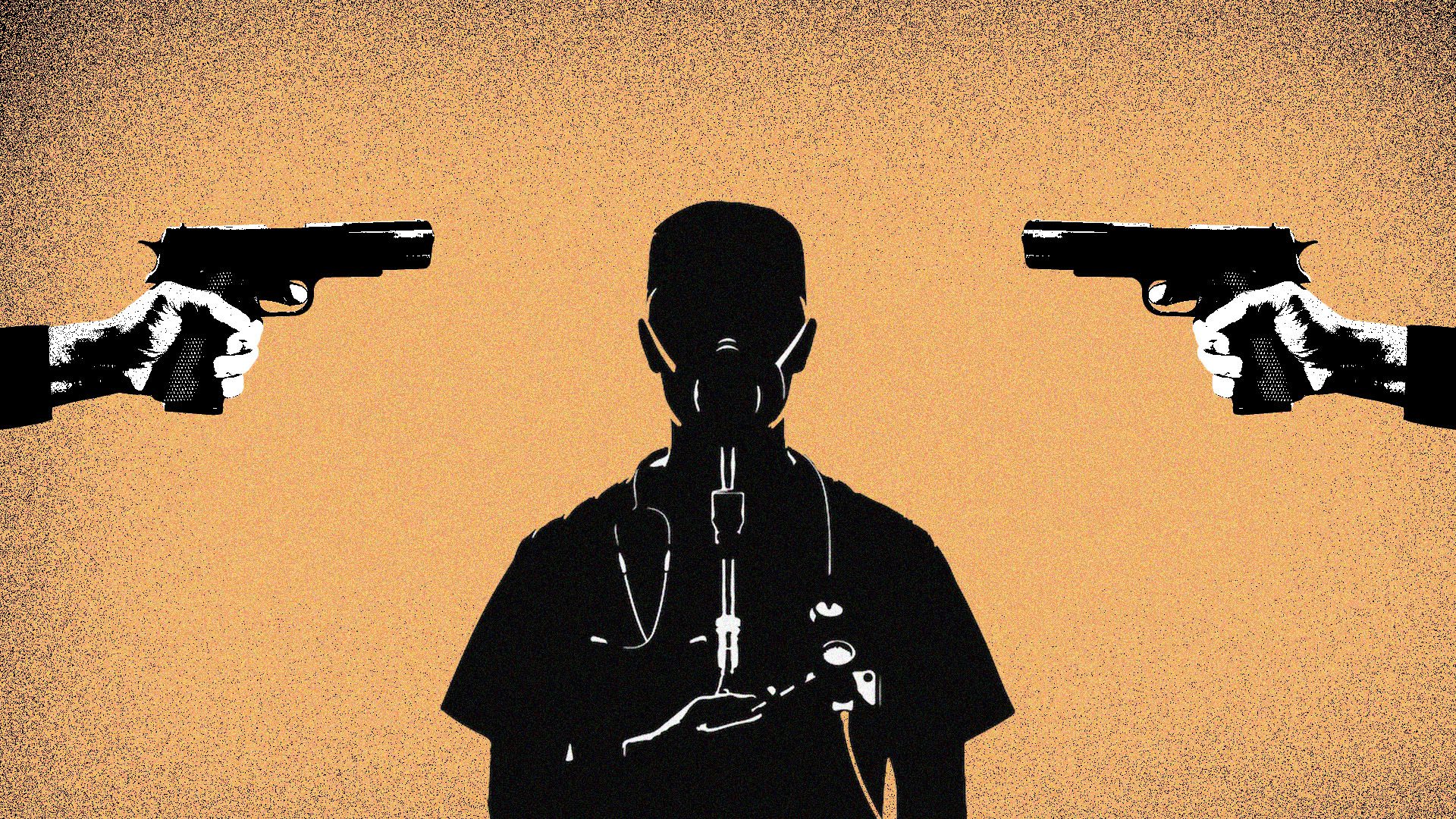
In Iraq, working in the medical field has become a risky endeavour. This is not only because of the inherent challenges of the profession itself, but also due to the threats and assaults that doctors face from the families of harmed patients.
These attacks are not always tribal. The perpetrators may belong to security forces or influential figures, who now pose a serious threat to the healthcare system.
The assaults range from verbal threats to physical violence and even kidnapping. Such incidents often go unpunished, as the attackers are shielded by influence and power that protects them from legal accountability.
One doctor, who preferred to remain anonymous, said he was threatened by the family of a patient who had undergone surgery, due to a delay in the patient’s recovery. Despite repeated assurances that the operation was successful and that the slow healing was due to the patient’s diabetes, which can delay wound recovery, the patient’s family believed a medical error had occurred during the surgery.
The doctor confirmed that his role had been limited to administering anaesthesia to the patient. Yet, the family still threatened him and demanded he pay them 20 million Iraqi dinars for his alleged negligence during the procedure, which, in the end, he paid.
In 2019, unknown attackers kidnapped Mohammed Salem Al-Khafaji, an anaesthetist. Days later, security forces found his body in the Al-Shu’la district of Baghdad, bearing gunshot wounds following his abduction.
Negative effects
The shortage of anaesthetists has a significant impact on the quality of medical services in Iraqi hospitals, particularly in surgical procedures that require close supervision of the patient’s condition during and after surgery. This shortage is considered one of the main reasons behind the deterioration of the healthcare system.
According to the World Federation of Societies of Anaesthesiologists (WFSA), the ratio of anaesthesiology specialists in Iraq is 1.9 per 100,000 citizens, a very low figure. To clarify, a higher ratio indicates that a country has a sufficient number of specialists. For example, Syria has a better ratio than Iraq at 2.32 per 100,000 citizens, and the number rises to 4.6 per 100,000 in Jordan.
For example, in some hospitals, there may not be enough anaesthetists to cover all scheduled surgeries, resulting in delays or even the cancellation of essential operations. This can directly impact a patient’s health and increase the burden on other medical teams.

Obstetrics and gynaecology specialist Dr. Malak Al-Jubouri stated that due to the shortage of anaesthetists, they are required to remain in the operating room for extended hours, sometimes up to 14 continuous hours, with the obligation to report back to the hospital the following day as well, because there was no one to replace them.