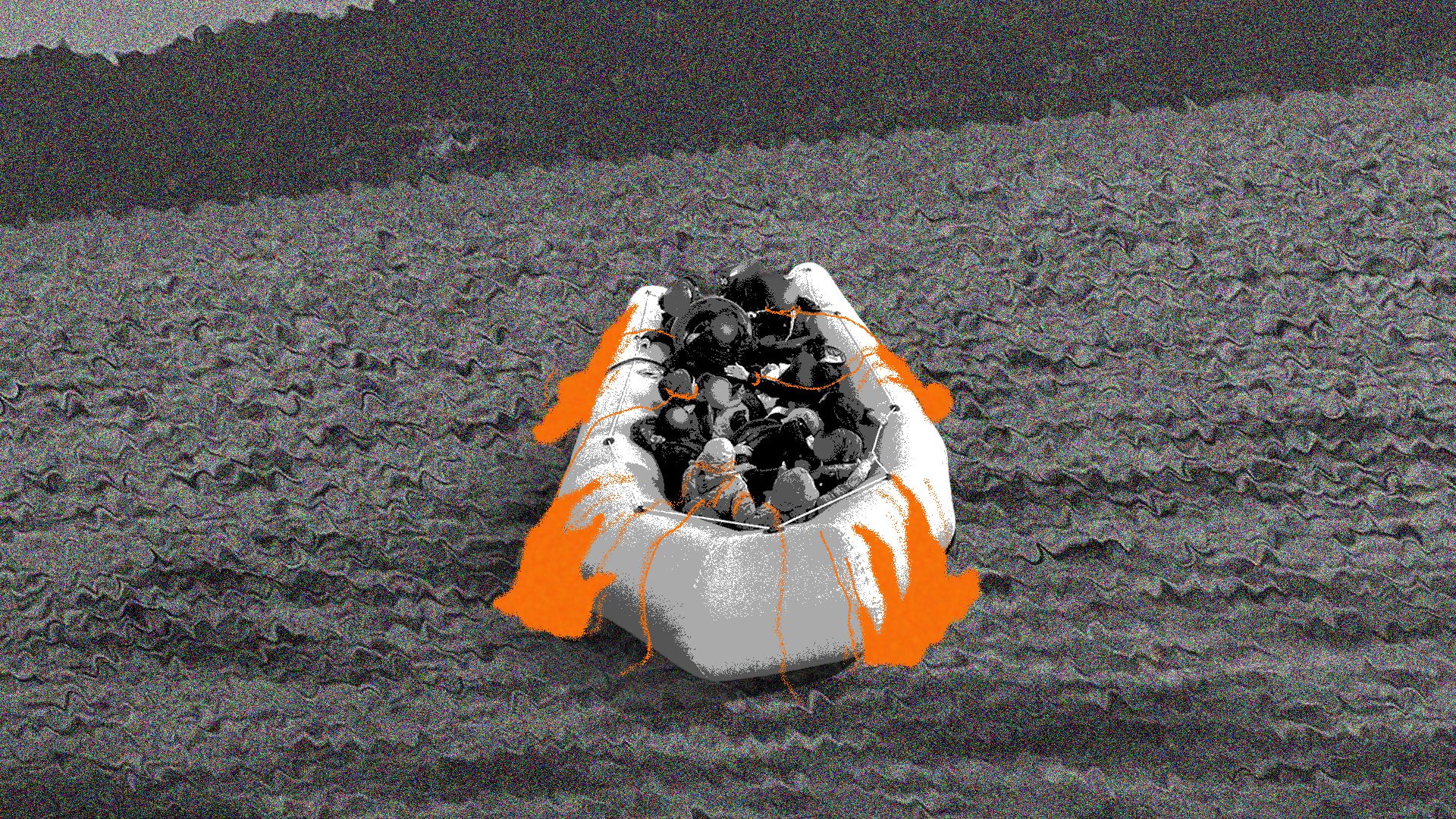

Mahabad boarded a small boat belonging to a Turkish smuggler, accompanied by her husband, Eissa, their five children, and several others, on the night of October 8, 2018.
The boat was meant to take them from the shores of the Turkish city of Izmir to the Greek coast across the Aegean Sea, in hope of reaching the “paradise of Europe”.
But the raging sea that night was stronger than Mahabad and Eissa’s dream. It swallowed everyone on board, and only Mahabad survived the disaster.
Her husband and five children disappeared that night, along with 15 other migrants who were with them on the boat.
The bodies of four of her children were lost to the depths of the sea, and all efforts to recover them failed.
The yacht is waiting!
Eissa had considered seeking asylum in Europe in search of a better life for himself and his family after losing his job as a car driver in Zakho district, north of Duhok province.
He sold all of their family possessions, house, gold, and more, to cover the cost of migration.
In early October 2018, he travelled with his family to the Turkish city of Istanbul, where he agreed with a smuggler to transport the entire family to Greece for 25,000 U.S. Dollars.
Three days after the agreement, they headed to a coastal area called Korbulu, near Izmir.
At the smuggler’s request, they stayed in an old building near the seashore. Over time, others arrived at the building, including women and children of Arab and Afghan nationalities, as well as a Kurdish family from the Kurdistan Region.
The final count reached 22 migrants.

The smuggler reassured them that he would take them to a Greek tourist island located in the middle of the sea, less than 30 km from the departure point.
“He told us the trip would take about half an hour,” Mahabad told Jummar.
The smuggler also told them that once they reached the island, they would be transferred to a Greek tourist boat, a yacht, that would safely take them to the Greek shores.
The boat they boarded was a small, inflatable dinghy that could only hold ten people. It was equipped with a worn-out engine that the driver struggled to start.
Fear and doubt crept over Mahabad when she saw the condition of the boat, and she asked her husband to back out. However, he and the smuggler tried to convince her that everything would be alright.

Migrants waiting to board a boat that will take them from Turkey to Greece.
Source: Page of the Lûtka Foundation, which specialises in refugee affairs.
When she refused, the smuggler threatened to kill her. Her husband tried to ease the tension, fearing the situation might escalate, and he ended up persuading her to board.
Everyone put on their orange life jackets, and the boat set off.
The wrath of the waves
Ten minutes after the boat set off, strong winds began to pick up, and the sea grew rough.
The deeper the boat went, the larger the waves became, some reaching nearly seven metres high, according to Mahabad’s estimate.
Children and women began to scream, while the men started chanting prayers loudly. The boat’s driver grew irritated and threatened to capsize the boat if they didn’t calm down. He ordered them to throw their bags and belongings overboard to reduce the weight on the boat.
In a moment of panic and confusion, the driver tried to make a sharp turn to escape a massive wave, but the boat flipped, throwing everyone into the sea.
The violent waves tossed people around and scattered them. In one terrifying moment, Mahabad saw a wave throw her husband near her. He was still alive. She grabbed his hands, and he asked her about the children. She told him she didn’t know what had happened to them.
“He was exhausted and breathing with difficulty,” Mahabad said.
He apologised to her and asked for forgiveness for convincing her to take this journey. But before she could reply, a massive wave came and separated them forever.
She floated in the cold water for over three hours until she felt her feet touch soft sand beneath her.
In that moment, she realised the waves had pushed her to shore. She summoned what strength she had left and crawled toward the land.
She had miraculously survived.
She sat on the shore for nearly an hour, staring at the sea, hoping it would return her husband and children alive, but her wish did not come true.
At that point, she didn’t know whether she was on the Turkish side or the Greek side, so she began wandering until a building came into view, flying the Turkish flag.
It was a Turkish Coast Guard station.
She approached the building and told those inside what had happened. Immediately, naval patrols were dispatched to search for the drowned.
The patrols recovered the bodies of her husband, one of her children, and several other migrants, but the bodies of her remaining four children were never found.
Turkish police investigated, and she was then taken to a hospital for treatment before returning to Zakho.
In coordination between the Kurdistan Regional Government and the Turkish government, the bodies of her husband and child were repatriated and buried in a cemetery in Zakho. Years later, Mahabad married another man. She now lives in Germany with her second husband and is going to therapy there.
Crossing the channel
Rezkar Hassan Tayeb resides in the British city of Manchester. His journey there from Duhok province was far from easy.
He didn’t cross the sea when he first left Iraq, but he did later.
Rezkar had travelled two years earlier with his family of four, flying from Erbil Airport to Serbia on a legal visa.
After staying four days in Serbia, they moved to Germany in a car operated by an Iraqi and a Syrian smuggler. The trip took 16 hours through rural roads and remote areas.
They stayed in Germany for about four months, but the German authorities denied them asylum. They were then forced to head to the UK via France.
In France, they arranged with smugglers to take them across the English Channel, which connects French and British territory, using an inflatable dinghy. The cost was agreed at 1,000 euros, approximately 1,200 U.S. Dollars per person.
When the time came to board the boat, Rezkar noticed that the smuggler had crammed over 70 people onto the vessel. Fearing it would capsize, he decided not to board.
Boats are often loaded beyond their capacity, according to the Lutka Foundation, an organisation which specialises in refugee affairs.
But before Rezkar could back out, some of the passengers suggested raising the fare to 1,500 euros, approximately 1,700 U.S. Dollars, per person in exchange for reducing the number of passengers to 50. They agreed on the proposal and presented it to the smuggler, who accepted.
The boat then set off toward the British coast on a journey that lasted over two hours, eventually bringing the migrants to the town of Dover in the United Kingdom.

They turned themselves in to the British police, who questioned them and then transferred them to the city of Manchester, where Rezkar currently lives with his family.
Rezkar endured all these hardships because he couldn’t find stable employment in Duhok after graduating from university in 2013. He had lived in hardship and poverty.
He sold everything he owned to fund the journey to Europe.
“I got a job in the construction sector in Manchester and now enjoy a decent standard of living,” he told Jummar.
The British courts have not yet ruled on his asylum case, but he is determined to stay there no matter the cost.
Hundreds lost
The Lutka Foundation for Refugees and Displaced Persons, based in the Sulaymaniyah province of the Kurdistan Region, reports that between 2015 and 2024, 345 Iraqi migrants from Kurdistan lost their lives during migration journeys to Europe, while another 248 went missing during the same period.
The foundation notes that over 760,000 Iraqis applied for asylum in European countries during that time, the majority being from Kurdistan.
According to the foundation, the number of asylum applications submitted by Iraqis to European countries has significantly declined over the past two years compared to previous years.

In 2023, a total of 19,500 asylum applications was registered. In 2024, the number rose to 23,400. By comparison, from 2015 to 2022, over 34,000 applications were submitted.
A recent agreement between Iraq and the United Kingdom has played a major role in reducing the number of migrants from the Kurdistan Region to Europe.
The agreement includes cooperation between both countries in combating human smuggling networks and returning irregular Iraqi migrants to their home country.
Meanwhile, Bakr Ali, head of the Association for Returned Refugees, told Jummar that available statistics show that European courts have rejected more than 4,000 asylum applications from Kurdistan citizens in recent years.
He added that Germany has deported several refugees to the Kurdistan Region, as part of increasingly strict European policies regarding the granting of asylum.

A family in Kurdistan welcomes their son returning from abroad.
Source: Page of the Lûtka Foundation, which specialises in refugee affairs.
He noted that several human traffickers have been arrested in Germany, the UK, and Kurdistan, and that many refugees have been deported from European countries to the Kurdistan Region because of the Iraq–UK agreement.
Ali attributed the high number of young Kurds migrating to Europe to deteriorating economic conditions after 2013, battles against ISIS, and the financial collapse that followed.
He explained that each migrant from the Kurdistan Region typically pays around 20,000 U.S. Dollars to smugglers to reach Europe through irregular routes.
He pointed out that most migrants are unemployed young people and university and institute graduates. He explained that residents of cities are more likely to migrate than those living in villages and rural areas.
This is because rural residents are often engaged in farming and livestock raising and are rarely out of work. Additionally, social ties remain strong in village communities, which encourages people to stay and discourages thoughts of migration.
Three routes
Despite the strict immigration measures imposed by Europe, people continue to migrate from Kurdistan.
Currently, there are three main routes used to smuggle migrants into Europe: two overland and one by sea.
Abu Agha, a smuggler who agreed to speak to Jummar under a pseudonym, explained that the first land route involves travelling on foot through forests and mountainous areas. It begins in Turkey and passes through Eastern European countries, eventually reaching Germany, the preferred destination for most migrants.
This journey takes about two weeks.
The second land route involves transporting a small number of individuals, no more than three, working with drivers who hide them on long-distance buses travelling from Turkey to a neighbouring European country. This journey takes around 3 to 4 days.
As for the sea route, migrants are transported by yachts and boats from Turkey to the Italian coast.
Abu Agha said he had been involved in human smuggling since 2002 and had never been pursued by authorities in any country.
He noted that smuggling Iraqis into Europe began back in the 1990s, primarily via the Aegean Sea toward the coasts of Greece and Italy.
Living in the forest
Estimates suggest that over one million people from the Kurdistan Region reside outside of Iraq, primarily in Europe, the United States, Australia, and Canada.
The migration of Iraqi Kurds to Europe and the U.S. dates back to the early 1960s. It continues to this day, according to Idris Abosh, a former member of the Kurdistan Parliament’s Foreign Relations and Diaspora Committee.
Abosh believes that Kurdish refugees abroad represent a vital force that can support Kurdistan politically, economically, and culturally. He emphasised the importance of organising this force and using it to form lobbying groups capable of influencing decision-makers worldwide and advocating for Kurdistan’s interests.
He attributed the ongoing migration of people from Kurdistan to several factors, most notably the ongoing political and economic disputes between the federal authorities and the Kurdistan Regional Government.

Abosh told Jummar that this has led to a decline in trust of Kurdistan’s citizens in the federal government, especially after Baghdad resorted to cutting the region’s budget and withholding salaries of public employees, pushing many to migrate in search of a better life.
He pointed out that large numbers of Iraqi Kurds poured into Europe and the United States in the 1970s, 1980s, and 1990s. Many of them found good opportunities, with some even rising to government and parliamentary positions in those countries.
However, more recent migrants are living in harsh conditions. Many are constantly pursued by the police for deportation to Iraq, and some are hiding in forests between France and Britain, according to Abosh.
Mahabad is not among those living in such awful circumstances. She married a man living in Germany, joined him there, and obtained stable legal residency.
Still, she cannot forget that achieving the European dream was preceded by a tragedy that wounded her, wounds that neither time nor therapy might ever heal.