
“Why, God? What did we do to deserve this?”
That was my mother’s voice, knocking on heaven’s door every night, blaming God and fate for years. It had echoed in my head from 15 November 2009 to this day, without an answer.
I was in year five. I came home in the afternoon in my navy pinafore and white shirt, my schoolbag heavy, my face tired after a long day. Everything seemed normal until I heard that my mother had given birth. In the room, I found her lying down, the new baby beside her after a stint at the midwife’s house. Silence filled our home. No one looked pleased—behind the quiet sat grief and refusal.
My parents had hoped for “a boy” after three girls. Once again, fate repeated itself: “a baby girl”.
As the eldest daughter, every one of my mother’s births left a deep mark on me. This one, in particular, never left my memory—or my parents’. Their disappointment was not only that she was a girl; it was what they discovered next.
The day after the birth, my father took the baby for routine tests. The doctor looked at her in surprise, turned to my father and said, “I’m sorry, but it looks as if your daughter was born with a different genetic make-up known as Down’s syndrome, caused by a chromosomal anomaly. It will affect her physical and cognitive development.” He explained that people with the syndrome have distinct facial features and body shape, and experience varying degrees of developmental delay, speech and learning difficulties, and slow growth.
My father froze, his features changing as if he carried the weight of the world. He stayed silent, stunned. No one in our family had had anything like this; it was a non-inherited genetic mutation in our line. The birth had been natural, the scans during pregnancy had shown nothing unusual, and as a newborn her appearance was hard to read.
He kept the news from my mother for days, afraid she would collapse. But it did not last. When she later went to the hospital for the baby’s vaccinations, a nurse happened to peer at the child with a bleak look and blurted out, harsh and graceless, “Your girl is Mongoloid… sick.”
My mother fainted from shock. When she came round, she wept and denied it, repeating “Why, God?” as if seeking a justice that would not come.
She stopped having children after Fatima. Those were some of the worst days our family endured. I was too young to grasp it all. They wished my little sister would die rather than grow up as a girl with Down’s syndrome in an unforgiving society.
My parents’ sorrow ran deeper than words. They saw beyond what we children could. They thought of a school she would never enter, a graduation we would never celebrate, and a society that would treat her as “sick”, “helpless”, “to be pitied”.
Sixteen years after Fatima’s birth, the world might not have changed, nor life with Down’s syndrome become easier, but I chose to tell her story—and ours—not in lament, but with love and respect for the experience she gave us.
A childhood coloured its own way
With time, Fatima grew and her physical and cognitive contours took shape.
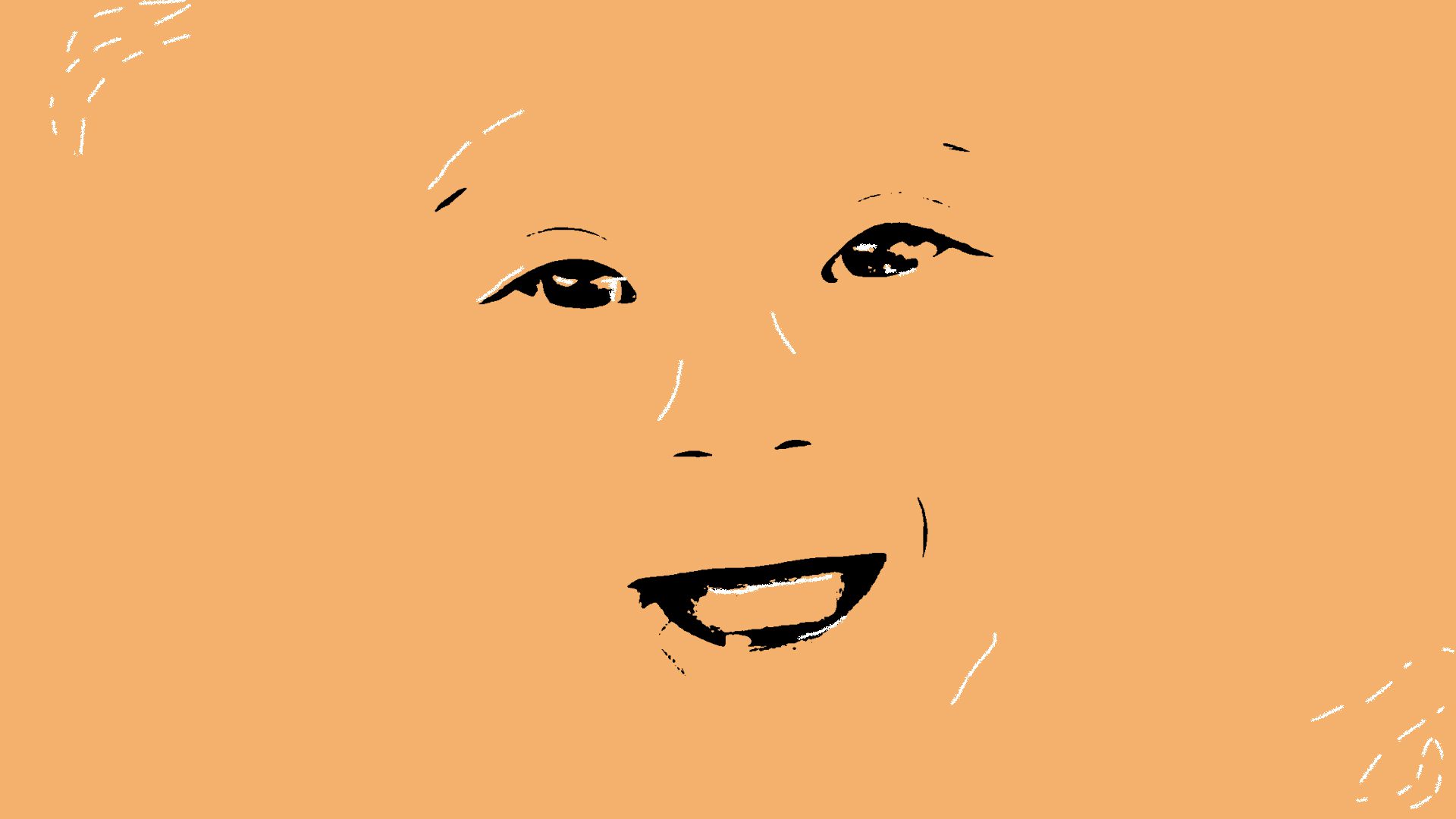
Her face was open and smooth; almond eyes with epicanthal folds; a small, neatly drawn nose; a slackness in the mouth that made her tongue slightly protrude; ears that seemed smaller than usual. A single palmar crease crossed her palm; the gap between her toes—especially the big toe and its neighbour—was wider. Her body’s softness and hypotonia made her pliable as dough. She had no strength in her movements and could not control her body easily; she could not even hold a baby’s bottle without help.
When Fatima was born—and for years after—my parents not only lacked knowledge about Down’s syndrome; they were unprepared, emotionally and mentally, to raise a child with it.
My mother was exhausted, lamenting her fate, haunted by comparisons with other women whose children ran and talked while Fatima did not grow—same weight, same features. Time changed; people changed; everything changed around me except her. She stayed the same. The years did not touch her—stuck there.
For a while, we believed she would stay like that forever.
After three years, she barely began to move—slowly, heavily turning over. At four and five, she started to crawl, then walk. Speech never came; even after eleven more years she had not mastered it. She remained like a toddler, saying “Baba”, “Mama”, and at times uttering sounds only we could decipher. It became our private language. Her mind, too, developed slowly; her abilities were limited; everything in her life was slow and late.
Her delays were not only in language. They showed up in daily behaviour, especially in her first ten years, once she began to walk, and our anxiety grew.
She did not distinguish right from wrong, nor safety from danger. We feared she would pick up a knife thinking it a toy, swallow pills or cleaning fluids, or walk out and get lost, unable to tell us from strangers.
Once, she disappeared for only moments. We combed the house, called her name again and again—nothing. We ran into the midday sun, searching the streets and shops nearby, panic rising. Later we found she had crawled under the bed to play and fallen asleep.
She could not mix with children, nor grasp their games or social cues. And, of course, none of them chose her either.
To us, her siblings, she was deeply loved from the start. I used to liken her to a docile puppy you long to cuddle and play with—someone you love by childish instinct and want to protect with your whole heart.
I was little then, looking at her with innocence, trying to find a bond without caring what others thought. Unlike my parents, I felt curious to live alongside a different sister. I enjoyed watching her and carrying her.
When Fatima turned eleven, I would sit with her in the garden for hours teaching her colours. “Red is the colour of an apple. Blue is the colour of the sky.”
The next day I would ask, “Where is red, Fatima?” She would point at a white tea cup.
“And where is blue?” She would point at the trees.
Her difference did not stop at forgetting colours and struggling to memorise. It reached her clothes too. It became normal for Fatima to burst into the room in mid-July wearing a coat over a jumper—or to insist, in winter, on her favourite bermuda shorts with a pink jacket.
Even now, at sixteen, we never leave her alone at home, not for a second.
We always checked she kept herself clean, reminded her to brush her teeth, kept up her night-time skincare, trimmed her nails, combed her hair.
It was not only hard for us; it was hard for her. Often she could not express her needs. She would retreat to her room and cry for no clear reason. After exhausting a thousand guesses, we would discover it was a scolding tone aimed at her by mistake, or a loud sound that upset her.
Fatima, at eleven, still carried inside her a tender, sensitive child with the understanding of a five-year-old.
“Lovely, not to be pitied”
In her first ten years, our greatest fear was losing sight of her for even a second. My father dreaded she might be exploited, assaulted, or abducted—especially amid rumours of children with syndromes being trafficked or forced to beg at junctions.
Fatima seldom left the house, perhaps once or twice a year—mostly for a doctor or unavoidable paperwork.
We found the stillness of her room’s walls kinder than the people outside, and our home wider than any place beyond it.
One of Fatima’s drawings
In recent years, I took up walking to steady my scattered thoughts. Once I decided to take Fatima with me to a nearby sports ground. We tried to avoid passers-by, but the stares devoured us. A woman we did not know kept staring, silent and unblinking, with a poisoned look and a smile of pity, as if she had uncovered a great secret: that the child before her had Down’s syndrome.
I felt disgust and wanted to start a row and “teach her a lesson”. She stared on, shameless. I had nothing left but to meet it with silence and leave. There was no point arguing.
It was not the first time, and surely not the last. It did not only happen outside. Even at home, Fatima did not escape looks of pity and inferiority from visitors. At family gatherings, one relative said, without any consideration for us or for Fatima, “Poor thing—this girl is sick… to be pitied.” I cut in: “No. Our Fatouma is lovely, not to be pitied.”
We had grown used to such comments, yet phrases like “They have a Mongoloid girl” or “Their daughter is, poor thing, disabled” still brought tears to my parents’ eyes.
No one grasped how those words cut us—her family, who loved her and refused the label of pity or the verdict of lack, without mercy, simply because she was born this way.
My parents, who had struggled even to accept Fatima in her early years, changed—slowly, gradually—from coercion and refusal to acceptance and familiarity, guided by parental instinct and their religious faith, which helped them through crises. They would say, “Perhaps we are rewarded for her… perhaps raising her is a recompense and intercession for us in the afterlife.”
Fatima’s unshakeable innocence deepened their tenderness. When my father came home from work, he sat beside her, making sure she stayed cool and ventilated in Iraq’s blistering summers, warm in its winters. He insisted she sleep next to him every night so he could check on her.
My mother made Fatima her companion at home, never out of sight. She fed and dressed her, cooked and cleaned with Fatima by her side like her own eyes—part of her. Fatima would either play with her toys or sit for long hours in front of the television watching Spacetoon, never tiring of Flona or The Care Bears. She did not understand much, but it filled her time.
We tried to give her a life that was almost normal—not only at home but outside too.
No school, public or private, accepted her. Even the private option, which we had hesitated over, proved futile. Fatima did not resemble other children; she could not mix or talk with them. Her understanding did not exceed that of a five-year-old. The schools shared our fear: that she would be bullied or ostracised if integrated.
A private school head told us he had full authority from the Ministry of Education to enrol children with the syndrome, but only on one condition: at least ten of them must register so he could open a dedicated class and hire a special-education team—without integrating them with other pupils, given their different abilities.
Neither condition was met. When I pressed him—“Surely you get such cases?”—he paused, then replied bluntly, “We’re a conservative society. No one wants to enrol a child like that. They see it as shame. The family would be mocked, bullied—even despised—if people knew they had a ‘Mongoloid’ child. And hiring a special-ed staff needs salaries. I can’t pay a whole team for one or two pupils.”
In theory, Fatima could have been in a school setting that lifted her out of isolation and grouped her with children with Down’s syndrome. In practice, neither society nor the state put in the work to make a right—enshrined in law for children and people with disabilities—a reality. This was Iraq as a whole: no special schools for the syndrome, no learning or rehabilitation centres in the provinces; a handful existed only in Baghdad.
The result was predictable: children with Down’s syndrome became a shunned class—marginalised and denied education and opportunity. Their symptoms varied in severity, but they all bore the burden of society’s ignorance, the state’s neglect, and the simple fact of being born with a syndrome for which they were not to blame.
A younger sister, in her own way
Despite Fatima’s isolation and the limits of a world bounded by our front gate, she filled the house with sudden laughter and tears. We got used to her presence. She shifted from burden and cause of sorrow to the family’s delight and source of joy. Her short black hair, innocent features, and a body that grew stronger and more beautiful transformed the space around her.
The older Fatima grew, the more certain I became that our family was held together because she was with us. We shared a sense of care and responsibility towards her, and she had witnessed our stages of life as we witnessed hers. We all grew—she and we—and she gave us a special kind of care in return.
My memory brimmed with tender daily scenes. On sad days she sat beside me in silence, stroking my hair with the gentlest touch. On nights when I was ill or despairing, she alone noticed my sorrow and asked, in her broken words, “Koki, what’s wrong?” When I clashed with the family and raised my voice, she waited until I calmed down, then came close without a word, as if sharing my silence.
One of Fatima’s drawings
Her laughter filled our home. Her spirit loved art and colour. By instinct, she took to drawing—long hours with crayons and paper, not so much drawing as flooding the page with colour, mixing green with yellow at whim.
Her musical taste was thoroughly Oriental. It fascinated me. At first she listened to Kadim Al-Sahir, even though she did not grasp the words or know how to say them. With time she favoured Sajida Obeid’s songs, dancing to them for hours without boredom. Lately, the Egyptian singer Mohamed Hamaki topped her playlist as she listened to his songs on repeat.
I watched and thought: she must be full of life inside, as if the outside did not concern her. By nature, she loved singing and belly dancing; she delighted in them, practising them as private rituals in a world without people or friends.
Days with her were like strolling among trees. We sang, cooked countless dishes and pastries, drew, and laughed—a world of our own, far from what others saw and thought.
She was the greatest gift we were given and, contrary to what much of society imagined with its narrow awareness, a source of gratitude.
“Who would be her support after we leave this life? When her siblings marry and start their own homes, who would take care of her?”
My parents never stopped thinking about Fatima’s future as she grew. Age frightened them. Responsibility weighed on them. She would always need them—always need someone to make her feel safe, as we did.
Who would look after her when they were gone? Who would dance with Fatima after us?