
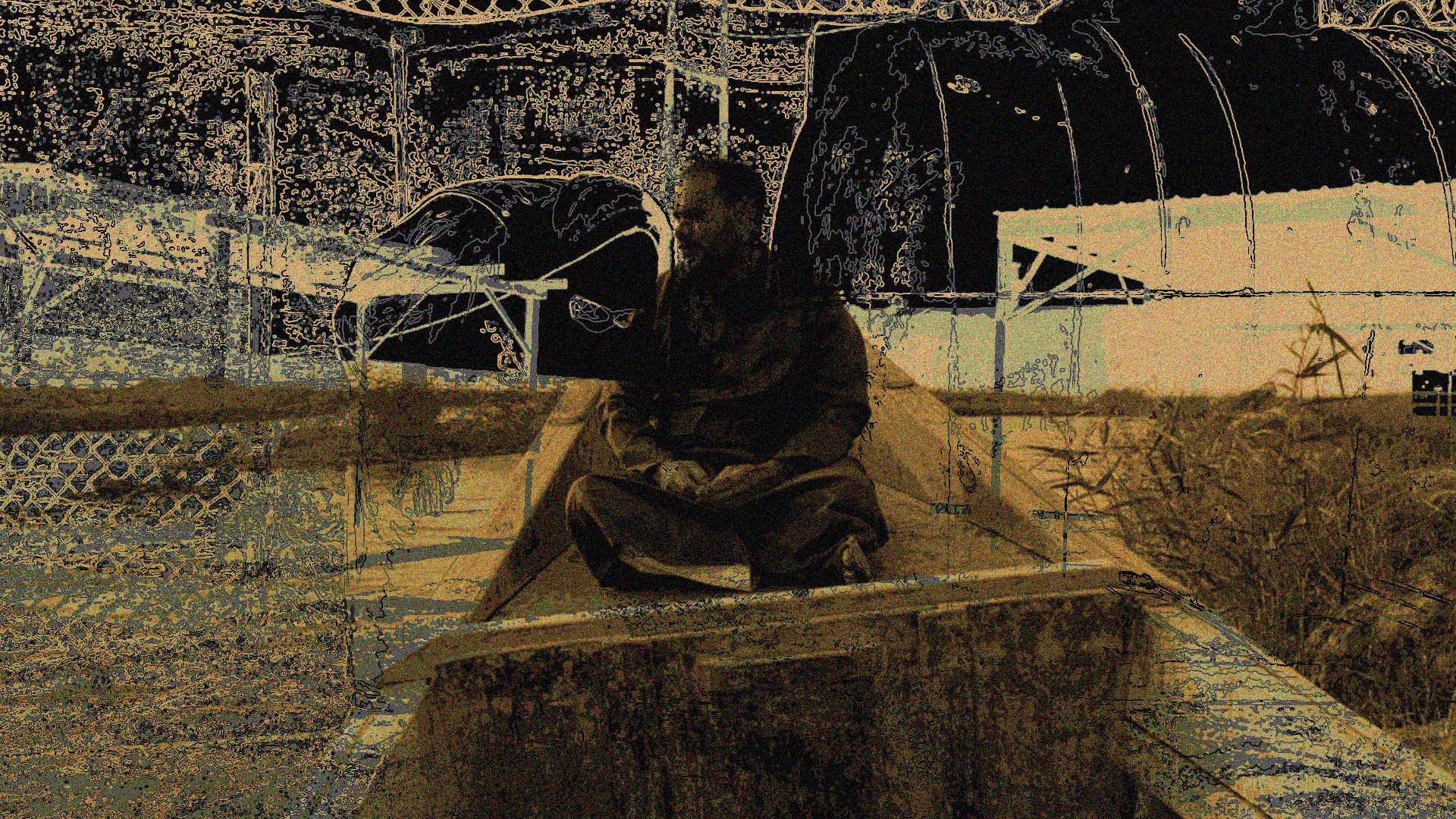

Hamidah Rayḥan reached out her hand to reveal the body of her young granddaughter, Ṭayf. Scattered red patches speckled the girl’s arms and legs. In a voice edged with pain and anger, she said, “Since we started washing our clothes with this water, these bumps began to appear on her skin”.
Hamidah lives in a village near Lake Habbaniyah, in Al-Ankur area, 45 kilometres south of Ramadi, where safe drinking water has become a distant dream and life is ground down by thirst and despair.
“We buy water from Ramadi in jerrycans sold by an itinerant vendor. The water delivered by lorries is not fit to drink; we only wash with it or use it for the coolers. Sometimes we go five days straight without a single drop.”

Hamidah opening the water tank she shares with neighbours. Source: the writer.
The hardship does not stop at thirst; it reaches the fields. “I used to be the first to harvest okra in the area, but now I cannot plant anything. Even our livestock cannot find water here. I walk long distances just to get them a little to drink.”
She glanced between her granddaughter and the withered pomegranate trees behind the house. “The trees died, the fish died, and there is no water for ablutions before prayer. Water gives life to everything—yet we now live a slow death.”
For more than 50 families in Al-Ankur, there remains only one option: to leave. The taps have run dry, and with them, the means to survive. Displacement began two years earlier as the crisis worsened and quickened with the onset of summer. There are no official figures documenting the number of people who left—neither from government bodies nor from civil society organisations.
Lake Habbaniyah has been the lifeline for residents in Al-Ankur, yet its level fell to less than 30 percent, no longer meeting even the bare minimum of daily needs. Jamal Odeh Samir, Anbar’s Director of Water Resources, stated on 14 August 2023 that the lake held only 500 million cubic metres of water, against a maximum capacity of three point three billion cubic metres, adding that in 2020 the lake was full to its brim. As for Al-Ankur’s population, Maḥmud Salim, Anbar’s Water Director, put it at around 12,000 people.

Residents tried to dig wells on their own, despite the risks of unregulated drilling. The need for water is severe. Their efforts stop at a depth of 90 metres, which is not enough to reach groundwater.
A second water-treatment station was brought online, but the problem did not end: it requires electricity, and that is another problem. Power cuts keep the plant out of service most of the time.
Hope now rests on Al-Ankur Water Project, which would connect the area to the River Euphrates. Work began less than a year earlier, but completion will require at least two years.
Anbar’s Directorate of Water undertook the project, which started on 11 August 2024, at a total cost of 38 billion Iraqi dinars, according to Jamal Odeh, the province’s Director of Water Resources.
Migration or thirst
Migration has become a serious option for residents. Muḥammad Aḥmad Khalifah, from Al-Ankur, summed it up in a single line: “50 percent of people will leave if the crisis continues… starting with me”.
“The village that once pulsed with life”, he said—as neighbours gazed with tired eyes at their empty tanks and hope thinned by the day— “It has lived through a water crisis for three years. It worsens over time, and Al-Ankur’s people no longer have enough even for a single night of water.”
The crisis stems mainly from the breakdown of the village’s dedicated water complex over the past three years. The local government and its departments have not repaired or maintained it. Since then, residents have relied on a complex shared with another area, but the water allocation is not enough.
The wells dug in Al-Ankur that fail to yield water. Source: the writer.
Khalifah explained: “We get water after midnight. If the electricity comes, the pressure is too low to reach the tanks, and sometimes it does not reach at all”. At best, he said, what reaches each home does not exceed 500 litres—insufficient for basic daily needs, especially given the need to run evaporative coolers that consume extra water in the absence of air-conditioning.
In July 2010, the UN General Assembly recognised the human right to water and sanitation as fundamental. It affirmed that every person has the right to sufficient quantities of water for personal and domestic use—between 50 and 100 litres per day—on condition that the water is safe and affordable, costing no more than three percent of household income. International standards also stress that a water source should be no more than 1,000 metres from the home and that collecting water should not take more than 30 minutes, to ensure fairness and ease of access.
The tragedy does not end with scarcity; it extends to contamination. “We received warnings that the water was unfit for human consumption”, Khalifah said. “But we are forced to use it for washing and cleaning only—and sometimes even that does not arrive”.
Complaints brought further penalties, he added: “When we protested about contamination, supplies were cut almost completely, as if we were being punished for demanding our right to life”.
The idle water complex in Al-Ankur. Source: the writer.
Alongside fishing, farming has been the backbone of life in Al-Ankur. But the lake has all but dried up, collapsing the fishing sector. “The lake died, and that is where the crisis began”, Khalifah said. “Villagers who once lived by fishing now head to Ramadi to work for a daily wage”.
In gruelling jobs—at factories, on building sites and the like—former fishermen now stand at the al-masṭar (day-labour pickup point), hoping for a day’s wage to cover the maswag (that night’s groceries). Such is thirst: if it does not kill, it alters.
Al-Ankur health post
Abdallah Adel, the medical assistant at Al-Ankur health post, warned of rising illnesses linked to unsafe water, confirming the spread of dermatological and gastrointestinal diseases, especially among children and women. “We see skin eruptions with redness and severe itching”, he said, “as well as diarrhoea and vomiting. There were also a few cases of scabies, though not many”.
Adel told Jummar: “The centre records between 15 and 20 skin cases per month, plus a small number of poisoning cases—between two and five only.’

He stressed that the centre needs large quantities of disinfectant tablets. ‘We dispensed around 500 strips in one month, while we need 800 to 1,000 to meet demand”.
He added: “The centre operates mornings only, with no night duty”. There is an urgent need for a laboratory to diagnose essential cases such as Helicobacter pylori infections caused by unsafe water, and urinary tract infections. “The centre currently lacks a laboratory unit”, he noted.
Pressure on the health post has risen sharply, he said: “The centre lacks the capacity to respond to this health emergency”.
Al-Ankur health post provides pharmacy services, school health, climate-change monitoring and vaccination. It opens only three days a week because staff lives far away.
On the response by the authorities, the medical assistant said teams from the Ministry of Health and international organisations have visited to assess the situation. Awareness programmes exist to reduce the risks of water-borne diseases, but, he emphasised, the essential need for residents is safe water for drinking and daily use.
Mobile tankers supply untreated water from what remains of the shallows of Lake Habbaniyah. Every 2,000 litres are sold to households for 10,000 Iraqi dinars—an economic burden residents cannot bear.
Twenty-seven areas in water crisis
Samim Salam al-Fahd, a water expert and head of the independent Euphrates Team for Water and Sustainable Environment, believes Anbar province faces a water crisis that threatens public health and drives residents to leave villages and rural areas for the cities.
Al-Fahd explained that falling levels in the River Euphrates and rising pollution have worsened the crisis, especially as many community-run treatment plants do not meet rigorous scientific standards, resulting in contaminated water being pumped into homes.
In Al-Ankur, two government treatment plants pump water from what remains of Lake Habbaniyah. One has been out of service for five years. The other lies to the east of Al-Ankur Al-Thaniyah (Second Al-Ankur), at the lake’s deepest point near the regulator feeding Lake Razazza. The western plant is also out of service.
Recently—over the past four months—and after many recommendations and appeals, the Al-Ankur 2 booster station was linked to the Al-Ankur 1 network. A rotation system began among residents, with the network divided to ensure water reaches everyone.
There is also a private plant in Al-Ankur Al-Thaniyah that filters and disinfects drinking water using reverse osmosis. Residents rely on it to buy treated, bottled water.
Al-Fahd noted that climate change and reduced inflows from Turkey—where discharges to Iraq fell from 500 cubic metres per second to under 200—had compounded the crisis.

Al-Fahd said his team has documented more than 27 locations with chronic water problems, including Rutbah district, Kubaysah sub-district, the villages of Al-Majar and Al-Ankur, Al-Nukhayb district, Al-Rahaliyah district, Al-Baghdadi sub-district, Ḥadithah district and Al-Qa’im district. Some of these areas depend entirely on wells that have begun to dry due to over-extraction and unregulated drilling.
According to his team’s data, one 120 families have left Al-Majar and Al-Ankur for Ramadi because of water scarcity.