
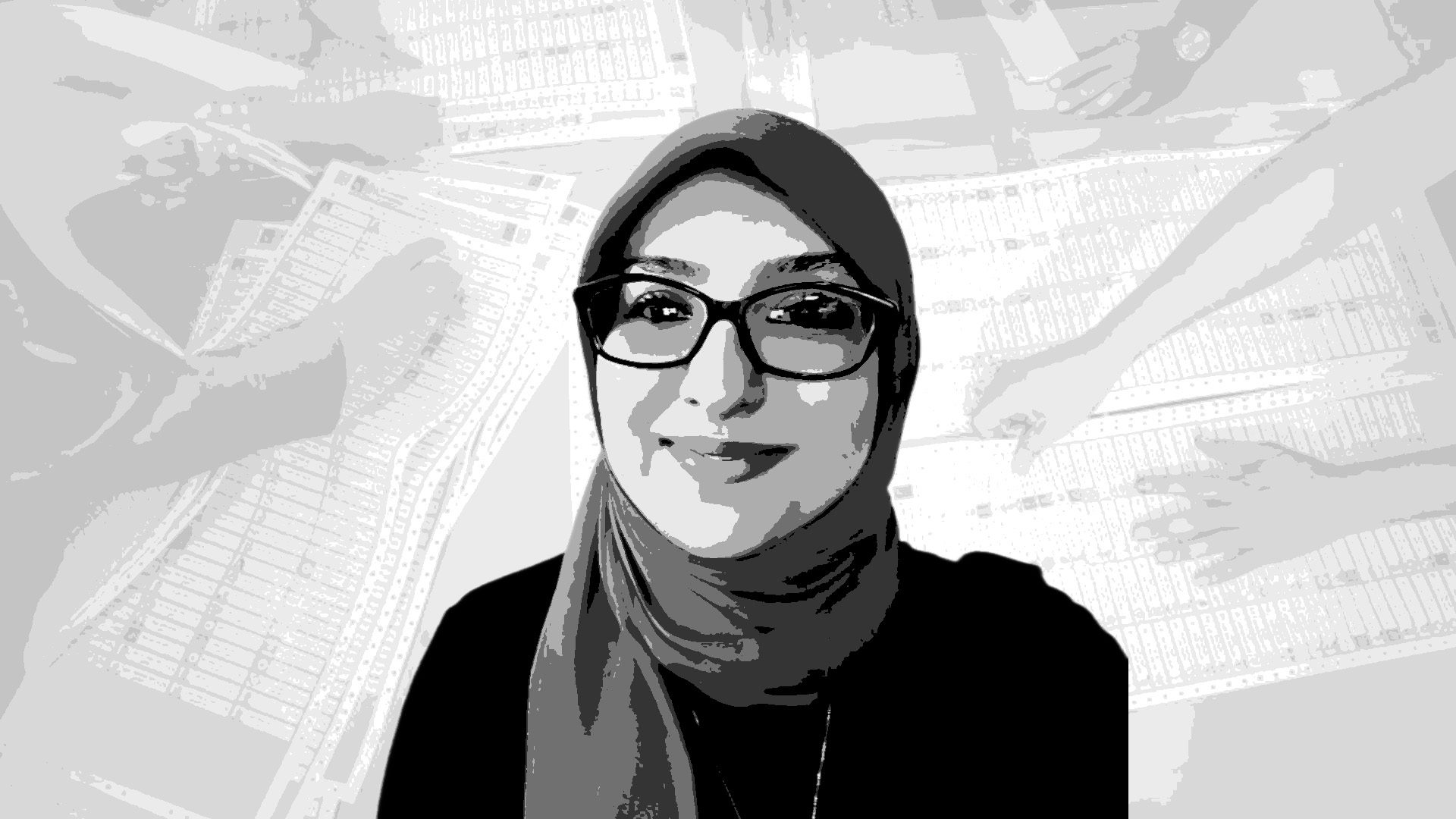

As Iraq prepares for another round of parliamentary elections amid deepening public disillusionment, questions of justice, accountability, and legitimacy once again dominate the national conversation. In this interview, Jummar speaks with Ruba Ali Al-Hassani, an interdisciplinary and sociolegal scholar who works on state–society relations, justice, and epistemic sovereignty in Iraq to centre and amplify voices on the ground in public discourse, analysis, and policy.
Currently completing her Doctor of Juridical Science at Osgoode Hall Law School, she has taught and conducted research at York University, Trent University, Lancaster University, and King’s College London.
Reflecting on the legacy of the Tishreen uprisings, she examines how corruption, misogyny, and epistemic violence continue to shape political life, and why, in her view, meaningful reform remains impossible without transitional justice and accountability.
Jummar: The Tishreen uprisings brought justice, accountability, and dignity to the centre of public discourse. How do you see those demands reflected—or sidelined—in the narratives around the current elections?
Ruba Ali Al-Hassani: Indeed, the Tishreen Movement centred justice, accountability, and integrity in public discourse. Unfortunately, we do not see much of any of them in the discourse surrounding the upcoming elections.

Tishreen demanded a separation between religion and state, yet election candidates today sectarianise public discourse, as they tend to do in every election cycle. The sectarianisation of identity, discourse, and politics tends to decline after elections but peaks during electoral campaigns to incentivise identity-based votes.
This is not to say that Tishreen’s narratives are absent during the current election cycle; they are present among the public, not the electoral candidates. Tishreeni sentiment, demands, and principles remain in public consciousness, and I would say that is Tishreen’s greatest accomplishment. This is why people see through politicians’ tendency to sectarianise the elections, so I doubt it will work this time.
J: Many Iraqis remain sceptical of elections as a vehicle for reform. From your work on state–society relations, what factors most shape this crisis of legitimacy?
RA: Iraqis have been rightfully sceptical of elections as a vehicle of reform for quite some time, and the primary reason for that is the lack of accountability for corruption and for perpetrators of violence.
In fact, corruption is itself a form of violence that often translates into physical, economic, epistemic, and emotional violence. The Khor Abdullah dispute (over maritime rights between Iraq and Kuwait) revealed high levels of corruption that qualify as high treason, yet there has been no accountability.

With every passing year, Iraqis lose faith in a system that holds no one accountable. The political elite simply does not represent the people or their demands and needs. It is safe to expect a far lower turnout for this upcoming election than the previous one.
J: Transitional justice has been a recurring demand since 2019. Do you see any meaningful steps being taken during this election cycle towards addressing forced disappearances, corruption, or protest killings?
RA: No meaningful steps have been taken during this or any previous election cycle towards addressing corruption, violence towards protestors, or forced disappearances. What we see during every election cycle is an attempt by candidates to weaponise forced disappearances and public sentiment to gain votes.
However, in reality, no measures have been taken to locate and free the forcibly disappeared. Instead, we see the increased securitisation of the public through the threat of, and actual, disappearances. Election cycles tend to be nothing but seasons of performativity.
J: How do you read the role of discourse and narrative wars between movements, political parties, and media in influencing voter turnout and perceptions of legitimacy?
RA: Tishreen shed light on what Iraq’s governments and non-governmental armed groups are willing to do to silence dissent. In addition to physical violence, which has not quite succeeded in silencing dissent, epistemic violence was the next natural step. It allowed certain parties to dominate public discourse and enforce a particular narrative.
We have seen this in the campaign to ban ‘gender’ in the media and in scholarship. We have also seen this in draft and passed legislation that aims to redefine the roles—and thus narratives—of women and other members of society.
This has also been translated into how the word Tishreeni is used today. Some conservative parties and affiliates use the terms Tishreeni and ‘activist’ or nāshiṭ in a derogatory sense as part of a character assassination of activists, who are painted as morally corrupt and disrespectful of social values and traditions. These attempts to redefine and label people aim to ‘other’ them during the current election cycle.
J: One of your research focuses is epistemic sovereignty. How are Iraqi voices being represented or silenced in the way these elections are covered internationally or in the internal debates in Iraq among protesters, politicians, or the media? How can international observers, academics, and media avoid reproducing the same narratives you criticised in your work?
RA: The many attempts to marginalise and silence dissent through weaponising certain labels have reached a point of misogyny that many women activists, journalists, and academics feel genuinely at risk of their lives. As some women academics in Iraq have told me, never in Iraqi history has misogyny reached such high levels, endangering women’s well-being.

While a male candidate was recently assassinated for his viewpoints, women candidates have recently been withdrawing from the election, citing threats to their lives and freedom to engage freely in public discourse. Any attempt to marginalise women’s voices—or the voices of activists and dissenters in general—is a threat to the public at large. They are denied their agency and sovereignty through various means of intimidation and violence.
Women have particularly lost faith in the system — the same one that has treated their fundamental rights and freedoms as pawns in political bargains. It is unrealistic to expect them to cast votes for recurring political figures who have robbed them of their rights, dignity, agency, and sovereignty.
Popular Iraqi sovereignty—the sovereignty of the people—is part and parcel of state sovereignty. If the people feel suffocated and are unable to dissent from the status quo, there would not be any tangible state- and peace-building practices.
International media and observers can support popular and diverse Iraqi voices by not regurgitating the narratives perpetuated by Iraqi politicians and the media outlets they control. Diverse Iraqi voices can be reached both on social media and offline—in the many gatherings, events, and other platforms of discourse such as Jummar media—that are still being engaged by those who refuse to back down.
J: Which reforms—legal, political, or institutional—would you identify as key benchmarks for assessing whether these elections can deliver meaningful change?
RA: As I have written in past publications, electoral reform is not possible without transitional justice. For the existing systems to be viewed as legitimate, there must be some accountability and judicial reform. Over the past few years, we have seen various examples of the politicisation of the judiciary, where problematic legislation has passed despite its unconstitutionality.
The recent amendments to the Personal Status Law and Amnesty Law have especially revealed that Iraqis’ fundamental rights and freedoms are hostage to a sectarian political bargaining system. Accountability of corrupt figures is a crucial benchmark, and we are yet to see that in Iraq. The lack of it is only making the Iraqi public angrier with time.
This is especially true after the fires that consumed commercial centres, restaurants, wedding halls, and other public venues where Iraqis expect to be safe with their families. In addition, institutional reform in higher education is a crucial benchmark that would signify meaningful change.
A forthcoming publication of mine explores how the degradation of higher education in Iraq signifies a rise in authoritarianism that aims to dumb down the population to control it. Critical thinking and theory are not encouraged enough in Iraqi curricula, and this is a red flag that begs for more public attention.

Additionally, the ban on Iraqi law professors’ media interviews discussing legal matters is also a red flag, as it furthers the concern that critical thinking and expert opinions are being crushed in favour of inexpert and acquiescent opinions perpetuated on political TV shows. As an academic in an Iraqi university once told me, “Iraqi society is being demolished, especially through education.”
J: How do you assess the role of international actors—donors, observers, media—in shaping not just the elections themselves, but the stories told about them?
RA: Tishreen revealed how desperate Iraqis are to be heard by the world, not just by Iraq’s political elite. When Adel Abdul Mahdi’s government enforced an internet and communications blackout, Iraqi protestors and activists used creative means to have their stories and voices reach international actors.
For over 20 years, international actors have de-centred Iraqi voices in favour of Western and other foreign interests, centring the US–Iran proxy war in their narratives. This denies Iraqis their sovereignty and marginalises them in a narrative that prioritises others’ interests.
It is not international actors’ role to shape the Iraqi elections and the stories told about them. Their role is to listen to and amplify diverse Iraqi voices, respect Iraqi willpower, and promote democratic elections that centre Iraqi voices.
J: In the years since Tishreen, new forms of grassroots organising have emerged. Do you see these infrastructures engaging with the elections, or are they carving out alternatives outside formal politics?
RA: I would say that Tishreeni mobilisation continues in various new forms which both engage with the elections and try to carve out grassroots alternatives outside formal politics. Since Tishreenis are not a monolith, these different forms of mobilisation have been diverse, ranging from diplomatic engagement with local government to online and offline discourses that promote awareness of fundamental rights and freedoms, as well as problematic legislation such as the amendments to the Personal Status Law.

It would be fair to say that the most pervasive form of mobilisation now is awareness promotion and the amplification of diverse voices. This, of course, is being challenged through counter-mobilisation by more conservative voices and armed factions.
J: There is tension between boycotting elections and participating pragmatically to gain small wins. How do you read this debate among social movements in Iraq today?
RA: We witnessed this debate during the previous Iraqi elections, and it was very heated then. Today, it may be less heated since more time has passed since the Tishreen protests.
With that said, distrust in the political elite and the electoral system has grown, especially as the lack of success by nascent Tishreeni political parties since the last election has shown that change from within the system is near impossible.
As such, talk of boycotting the elections is less debated now than it was last time. There is less resistance to boycotting, as the ethnosectarian authoritarian system has demonstrated its resilience, with or without elections.
